Commonwealth journey

From Coimbatore
to Imperial.

A story built through clinical training, scientific curiosity, community service, national recognition and the conviction to keep moving forward.

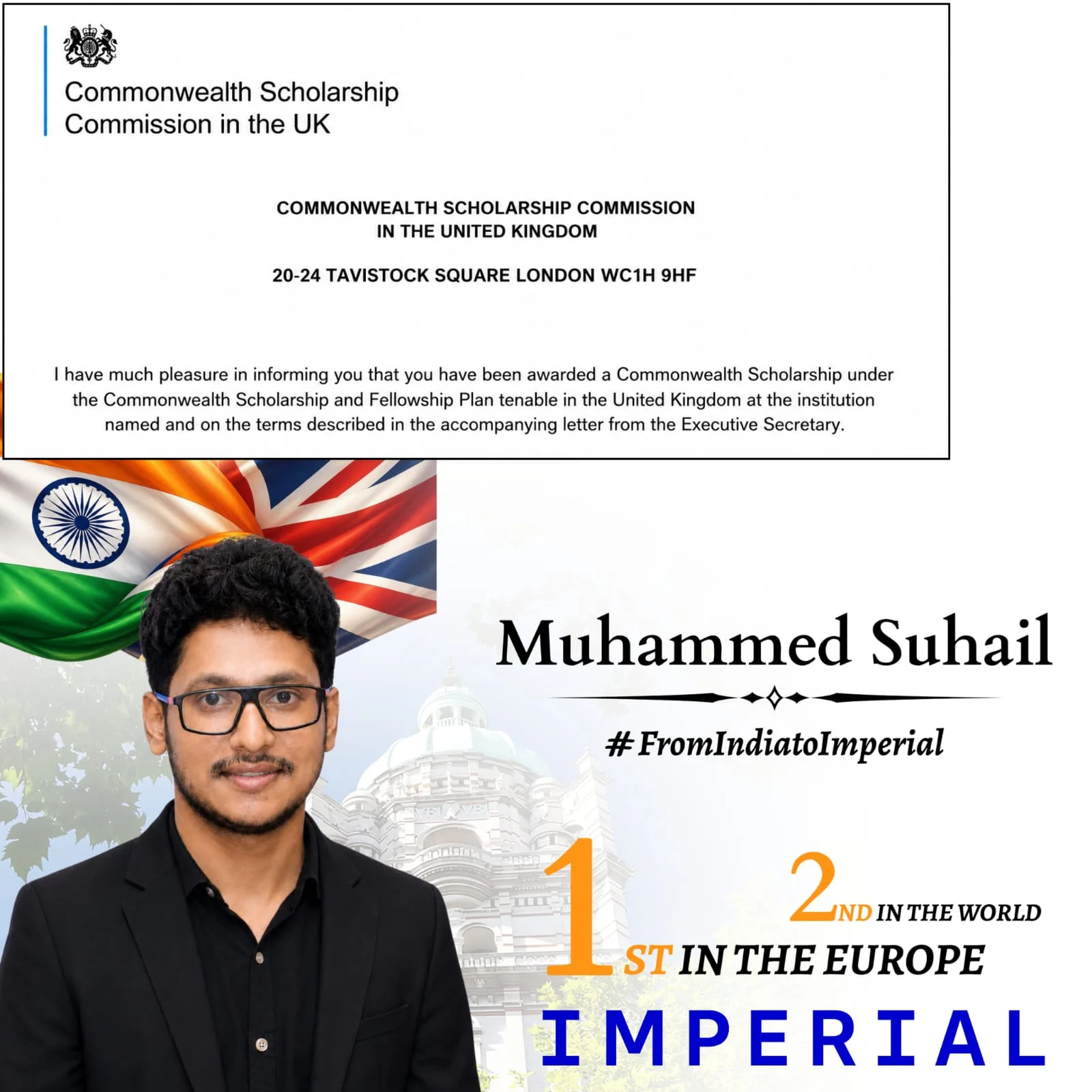
Muhammed Suhail pictured with his Commonwealth Scholarship award and Imperial College London journey graphic #FromIndiaToImperial

The turning point

A scholarship is never just a destination.

On 28 May 2026 at 2:08 p.m., an email confirmed my provisional selection. On 10 July, the final Confirmation of Award made the journey official. For a first-generation graduate, the scholarship is both an opportunity to learn and a responsibility to return knowledge, networks and better healthcare thinking to the communities that made the journey possible.

01

The moment

The email made years of quiet preparation visible.

“The award was not the moment I became ready. It was the moment years of quiet preparation finally became visible.”

The email arrived on 28 May 2026 at 2:08 p.m. I had been provisionally selected for a Commonwealth Master's Scholarship. The sentence was short. The road behind it was not.

It ran through hospital wards in Coimbatore, more than 4,500 hours of supervised clinical training, research posters, community health work, difficult essay drafts, reference requests and long months when there was nothing to do except keep preparing. On 10 July 2026, the final Confirmation of Award made the opportunity official: I would study MSc Cardiovascular and Respiratory Healthcare at Imperial College London.

My professional identity began with patient care. Across cardiology, respiratory medicine, neurology, nephrology, gastroenterology, emergency medicine and critical care, I learned that better outcomes depend on more than one clinician or one intervention. They depend on teams, evidence, training and systems that work.

The scholarship therefore feels larger than a personal award. My media record described it as marking four firsts: the first Physician Associate from India, Allied Health Sciences graduate from India, scholar from PSG Institutions and scholar from The Tamil Nadu Dr. M.G.R. Medical University to receive the Commonwealth Master's Scholarship. I carry those claims with gratitude and responsibility. A first should make the second, tenth and hundredth journey easier.

The story in one line

I did not build a scholarship application around prestige. I built it around a health problem I want to help solve.
02

The foundation

Clinical training gave the ambition a real-world purpose.

The Commonwealth Master's Scholarship is a UK Government-funded award administered by the Commonwealth Scholarship Commission in the UK. It supports candidates from eligible low- and middle-income Commonwealth countries to undertake full-time taught master's study in the United Kingdom. Its purpose reaches beyond education: advanced study must connect to sustainable development in the scholar's home country.

For my 2026-27 award, the confirmed support includes the full overseas tuition fee of GBP 47,300, a monthly stipend of GBP 2,000, return airfare, a GBP 200 study-travel grant and a GBP 225 thesis grant, alongside other eligible support under the scholarship terms. The award is tenable at Imperial College London from 26 September 2026 to 30 September 2027.

My proposed work aligns with the health-focused development theme of improving population health, health systems and capacity. Cardiovascular and respiratory diseases are not abstract academic topics to me. They are clinical and system-level challenges I met during training and want to address through research, education and better care pathways.

I completed a BSc Physician Associate at PSG Institute of Medical Sciences and Research with First Class with Distinction, and graduated as course topper. Alongside more than 4,500 supervised clinical hours, I received the National Student of the Year Award and a gold medal for a scientific paper on Physician Associate task distribution. Research, conferences and preventive-health initiatives reaching more than 5,000 students kept the work grounded in people rather than paper.

03

Course before prestige

I chose the capability I needed before choosing the university name.

Imperial's MSc Cardiovascular and Respiratory Healthcare is delivered by the National Heart and Lung Institute. Its combination of clinical knowledge, research design, quality in healthcare, new technologies and a substantial original research project matched the bridge I was seeking: clinical practice on one side; research, education and health-system improvement on the other.

I examined the course as carefully as I would examine a clinical case. What problem is it designed to address? Which modules build the skills I lack? What research environment will test my ideas? How will the learning travel back to India? When those answers aligned, the choice became defensible to the university, to the scholarship panel and, most importantly, to myself.

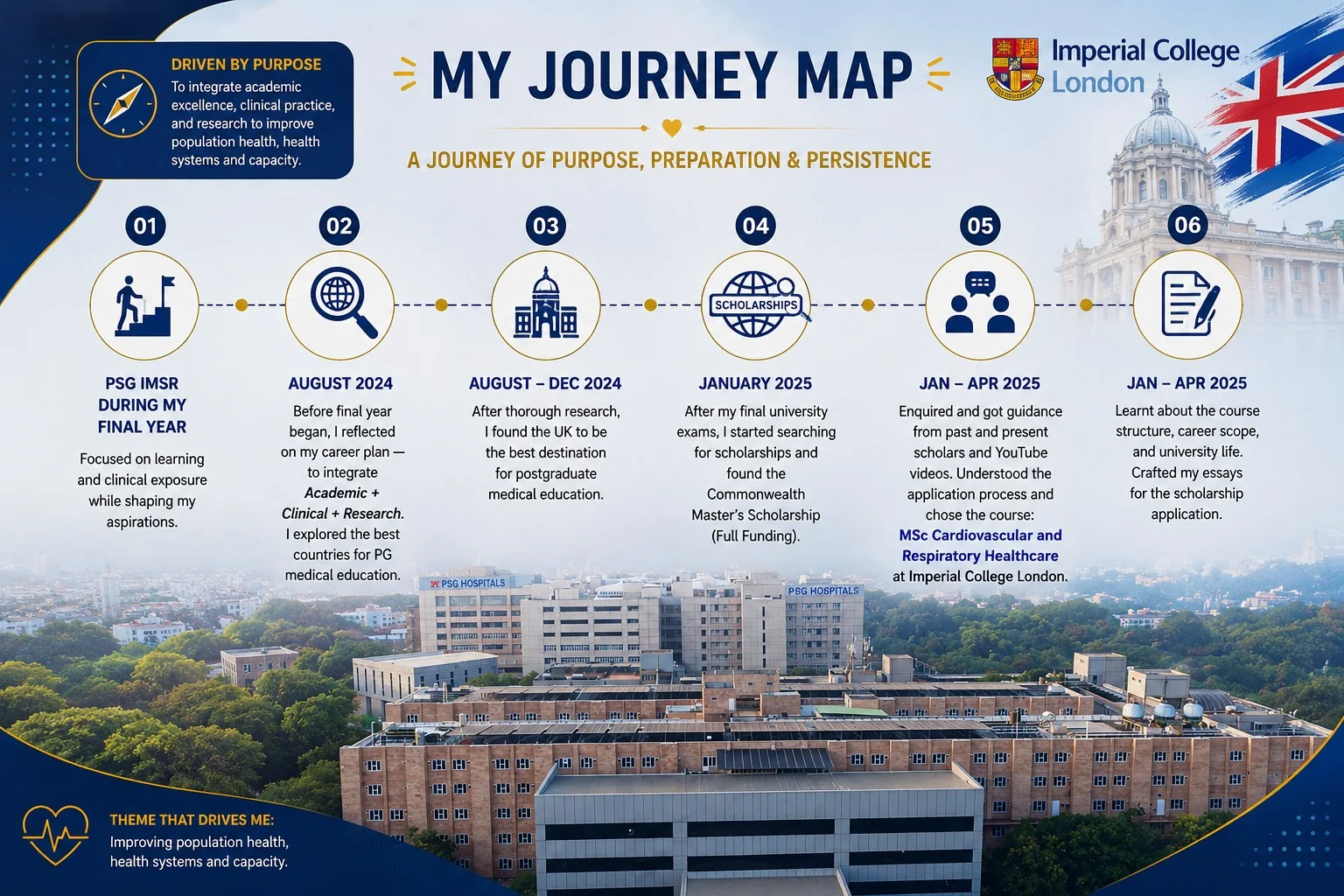
The search began in August 2024, before my final year, when I decided to integrate academic work, clinical practice and research. Between August and December, I compared countries and postgraduate medical-education routes. By January 2025, I was actively searching for fully funded opportunities and found the Commonwealth Master's Scholarship.

Official websites gave me the rules; people gave me the texture. I contacted past and present scholars, watched application explainers and studied course structures, but checked every informal insight against official CSC, Ministry of Education and Imperial sources. That habit prevented hearsay from becoming strategy.

For the Imperial application, I worked backwards from fit. I matched the programme's research and healthcare focus to evidence from cardiology and respiratory rotations, scientific presentations, published work, patient-facing experience, community engagement and advocacy. Only then did I write. A course application is not a biography; it is an argument that your past has prepared you for a specific next step.

I scored 125 out of 160 on the Duolingo English Test and an overall IELTS Academic band of 6.5, both recorded at CEFR B2. Repeated timed practice, complete spoken responses and error review turned each mock test into a diagnosis rather than a score. Language preparation was not only an admission condition; it trained me to explain ideas and enter an international classroom with confidence.

The application, mapped

Purpose. Preparation.
Persistence.

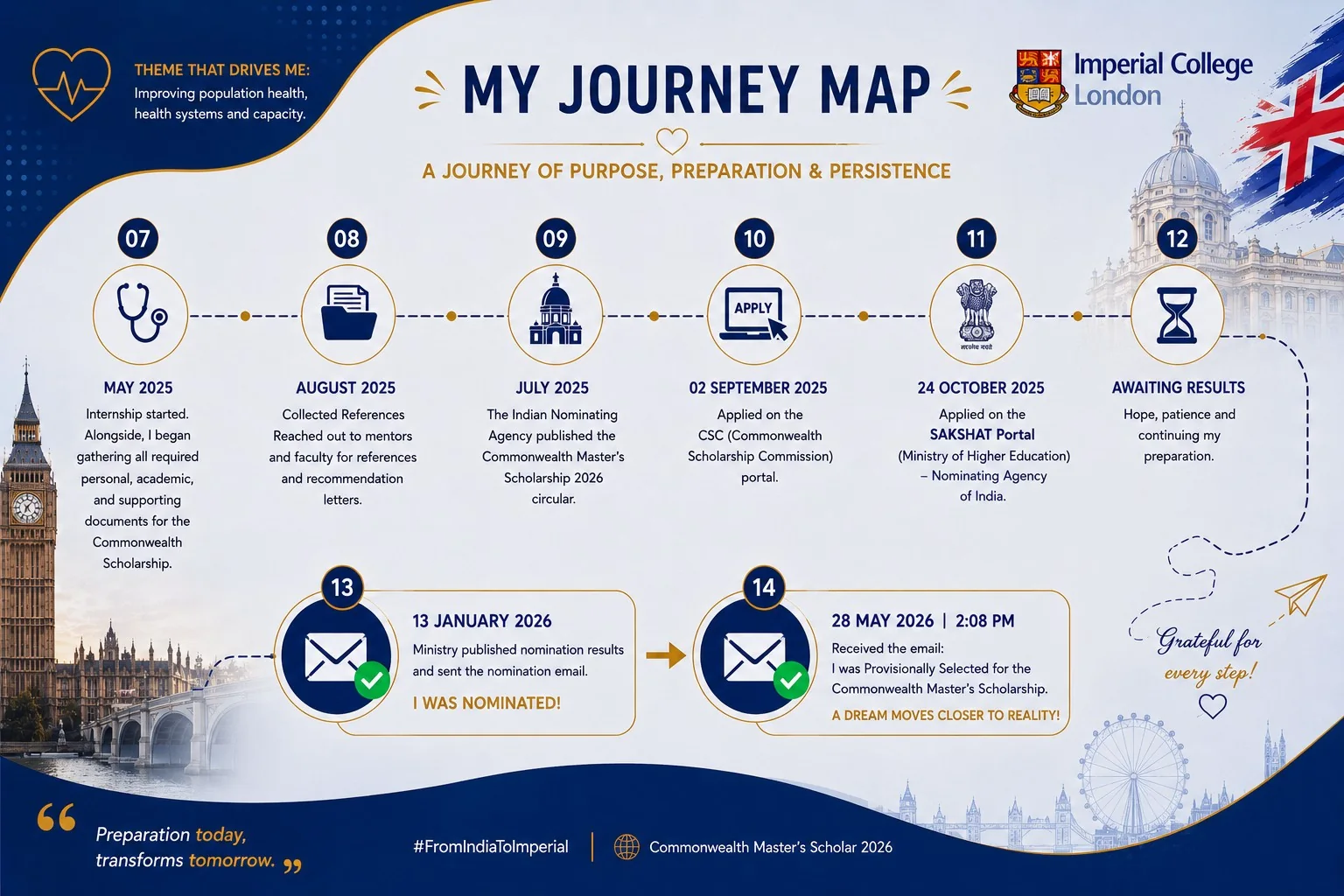
Fourteen milestones trace the path from choosing a postgraduate direction to nomination and provisional selection for the 2026 Commonwealth Master's Scholarship.

Journey map steps one to six, from final-year clinical training and course research to preparing Commonwealth Scholarship essays
Map 01 · Foundation Open full size ↗
Journey map steps seven to fourteen, from the 2025 internship and reference collection to nomination and Commonwealth Scholarship selection
Map 02 · Application Open full size ↗
04

The application

Preparation began months before submission.

I separated preparation from submission. When my internship started in May 2025, I began gathering academic, personal and supporting documents. The Indian nominating agency published its 2026 call in July. In August, I approached mentors and faculty members for references and recommendation letters.

The essays were the centre of the work. I built them around one connected chain: clinical exposure showed me a problem; research taught me to examine it; Imperial would give me advanced tools; returning to India would let me apply and share those tools. Every section had a different job, but all sections pointed in the same direction.

Conversations with scholars made the application more specific. They did not give me sentences to borrow; they gave me questions to confront. Is the development problem defined tightly enough? Does the course supply the missing capability? Is the return plan realistic for the first two years? Can a referee verify the qualities I claim?

My academic record also includes the India Future Leader Scholarship 2026 from Imperial College London and recognition as a Government of Tamil Nadu Chief Minister Scholar recipient. I value each award, but the Commonwealth Scholarship was the strongest fit because it combined full financial support with a development mandate. The funding makes study possible; the mandate asks what I will do with it.

I cannot know every selection discussion, so I answer with humility: I believe coherence made the difference. Academic results, clinical training, research, publications, leadership, advocacy and community service did not appear as unrelated achievements. They supported one case: I had seen a health need, started building the skills to examine it, chosen the right programme and formed a credible plan to return and multiply the benefit.

The hardest part was compression. A life is messy; an application has word limits. I had to decide which evidence advanced the argument and which achievement, however meaningful, distracted from it. Waiting was difficult in another way. I continued learning, strengthening my records and preparing for outcomes I could not control.

My application equation

Evidence showed readiness. Relevance explained the course. Return plans converted opportunity into public value.

05

Development impact

Learn. Translate. Multiply.

Learn means gaining stronger capability in cardiovascular and respiratory science, research design, quality improvement and the responsible use of new technologies. Translate means adapting those lessons to Indian clinical, educational and resource settings rather than importing them unchanged. Multiply means sharing skills through teaching, research collaboration, clinical protocols, advocacy and future mentorship.

This keeps impact practical. A scholarship year cannot solve a national health challenge. It can equip one person to make better contributions, build better teams and help create systems that continue after the degree ends.

Referees need time and substance. They should understand the programme, scholarship theme, assessed qualities and evidence they directly observed. One specific act of leadership says more than five adjectives. I gathered references in August 2025, before the pressure of final deadlines.

If I repeated the process, I would build an evidence bank even earlier, recording the date, context, action, result and lesson from every meaningful project, clinical responsibility, presentation, community activity and leadership contribution. I would complete English testing and course research sooner, brief referees with more lead time and draft the return plan before the scholarship essays.

Applicants should avoid universal essays with only the university name changed. Do not confuse hardship with impact, ambition with a plan, or a list of certificates with evidence of growth. A previous scholar's story can teach structure, but it cannot supply your reasons. If the course, development problem and career plan do not connect, fix the plan before polishing the prose.

06

The wider purpose

The application carries one name; its purpose should reach further.

“Preparation today transforms tomorrow. The application may carry one name, but its purpose should reach far beyond one person.”

Do not apologise for an unusual starting point. Explain what it taught you to see. Scholarship panels are looking for academic ability, a well-chosen programme and potential for development impact. If your profession is under-recognised, make its contribution legible. If your institution is not globally known, make your evidence precise. If your path is unusual, show why that perspective matters.

Visibility changes what students believe is possible. Physician Associates and allied health professionals contribute to patient care, multidisciplinary teams, research, education and service delivery, yet their routes into international scholarship and leadership are not always visible.

I want this journey to become a reference point, not a monument. If one student begins a research project, asks for mentorship, applies to a demanding course or sees a health-system role beyond the limits others placed on the profession, the value of the award has already started to multiply.

At Imperial, I will deepen my understanding of cardiovascular and respiratory healthcare, research methods, quality improvement and emerging approaches to diagnosis and management. My interests include clinical and translational research, evidence-based care, artificial intelligence-supported diagnostics, medical education and health-system capacity building.

The long-term goal is to return knowledge to practice: stronger cardiopulmonary care, better clinical training, wider research capacity and sustainable healthcare innovation in India. The degree is one year. The responsibility is much longer.

Application chronology

Preparation,
then submission.

Eight dates capture the path from gathering evidence to the final Confirmation of Award.

  1. 01 May 2025

    Internship began and I started gathering academic, personal and supporting documents.

  2. 02 July 2025

    The Indian nominating agency published the Commonwealth Master's Scholarship 2026 call.

  3. 03 August 2025

    I approached mentors and faculty for detailed references and recommendation letters.

  4. 04 2 September 2025

    I submitted the application through the Commonwealth Scholarship Commission system.

  5. 05 24 October 2025

    I completed the national application through the Ministry of Education SAKSHAT portal.

  6. 06 13 January 2026

    The Ministry of Education confirmed my national nomination.

  7. 07 28 May 2026 · 2:08 p.m.

    The provisional-selection email arrived.

  8. 08 10 July 2026

    The final Confirmation of Award made the scholarship official.

For future applicants

Seven moves for a credible application.

Practical lessons from the process, designed to protect your own voice, evidence and purpose.

  1. 01

    Start with a problem, not a scholarship

    Define the development challenge, who is affected, where the gap appears and why it matters. Funding should enter after the problem, not before it.

  2. 02

    Build an evidence bank

    Record the situation, your action, the result and what changed in your thinking. This becomes raw material for essays, references and interviews.

  3. 03

    Choose the course by capability

    Identify the skills your current path cannot provide, then find modules, research and teaching that close those gaps. Course-level fit wins the argument.

  4. 04

    Map every essay to one direction

    Academic merit, study plans, leadership, development impact and career plans should reveal distinct but connected sides of the same candidate.

  5. 05

    Give referees evidence and time

    Share your current CV, course details, criteria, deadlines and examples they directly observed. Help them remember; let them judge.

  6. 06

    Write a staged return plan

    Separate what is possible in the first year, three to five years and the longer horizon. Name likely partners, constraints and sequence.

  7. 07

    Run a consistency check

    Check every date, award, score, institution name and numerical claim across the scholarship form, national portal, university application, CV and references.

The wider timeline

Education, clinical work and recognition.

The Commonwealth story sits within a longer path of training, research, service and future study.

01
Education Dec 2021

BSc Physician Associate begins

Started undergraduate training at PSG Institute of Medical Sciences & Research, building a foundation in medical sciences, patient assessment and evidence-based care.

02
Clinical Aug–Dec 2023

First community-facing clinical role

Worked as a supervised clinical trainee at Al-Shifa Clinic while beginning a growing programme of scientific poster presentations and community service.

03
Research 2024

Research questions take shape

Presented work on coronary imaging, patient-ventilator synchrony, clinical practice pathways and climate-related health risks.

04
Recognition Jan 2025

The Great Poet Bharathiar Award

Felicitation by the Hon'ble Governor of Tamil Nadu after winning a state-level essay competition.

05
Clinical May 2025–May 2026

Full-time clinical internship

Rotations across cardiology, respiratory medicine, neurology, nephrology, gastroenterology, orthopaedics, oncology, emergency medicine and critical care.

06
Recognition Oct 2025

National Student of the Year

Received national recognition from the Indian Association of Physician Associates and a Gold Medal for a time-and-task analysis of the Physician Associate workforce.

07
Education 29 May 2026

Graduation and Course Topper

Completed the BSc Physician Associate with First Class with Distinction and received the Certificate of Honour as Course Topper.

08
Recognition 10 Jul 2026

Commonwealth Scholarship confirmed

The final Confirmation of Award made the 2026 Commonwealth Master's Scholarship official, opening the path from Coimbatore to Imperial College London.

09
Milestone Reached Sep 2026–Sep 2027
✨ Reached Imperial · Commonwealth Journey Started

Imperial College London

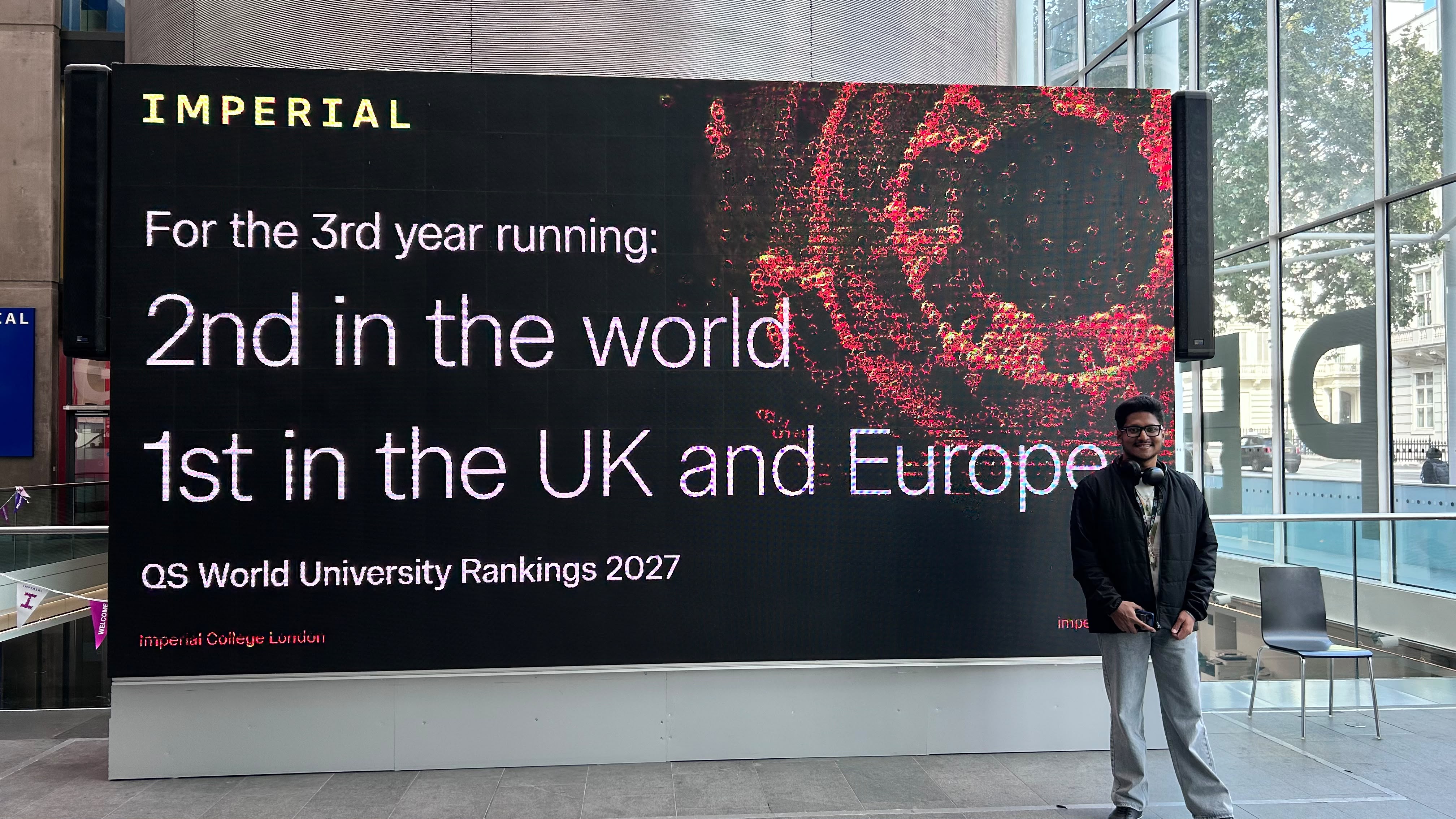
Officially arrived at Imperial College London (Ranked #2 in the World, #1 in the UK & Europe) to commence MSc Cardiovascular and Respiratory Healthcare at the National Heart and Lung Institute under the Commonwealth Master's Scholarship.

Muhammed Suhail at Imperial College London QS World Rankings Screen
🏛️ Imperial College London: 2nd in the World, 1st in the UK & Europe · Started my Commonwealth journey

Next chapter · September 2026

Research. Clinical insight.
Better outcomes.

The MSc at Imperial's National Heart and Lung Institute will develop the methods, perspective and collaborations needed to improve cardiorespiratory healthcare delivery.